In front of the John Lennon Wall in Prague.


Saturday, August 24, 2013

Open the Door

Last week at the magical A Room of Her Own Writers Retreat at Ghost Ranch, I participated in a guided imagery exercise led by Bhanu Kapil.  Much to my surprise, I found that I am highly susceptible to such exercises.  Being a pragmatic realist, I never would have thought I could be able to envision what waits for me in my subconscious.  In this particular exercise, Bhanu asked her audience to close their eyes and imagine a door - a door that would lead each of us to a place we wanted to be.  Not only was I able to visualize that place, but I was also able to use the ideas I gathered while I was there by writing about it later on.


The next day, as I began a hike up to Chimney Rock, I found a gate at the trail head.  I'm sure it is meant to keep animals such as dogs or horses off the trail, but I was struck by how the ritual of opening that gate - another door - prepared me to enter the rocky beauty of that trail.  And of course I was reminded of the work I had done with Bhanu.

I know that what I was looking for behind the  door I pictured is a clearer idea of how to keep writing even in the face of a very  demanding school year.  I want to stay on my writing path, just as I stayed true to the trail up to Chimney Rock.  I opened that door at the AROHO retreat, and so far have been walking my writing path during this first week back at teaching.  And I'm determined to keep going.

We all have closed doors in our lives.  Some are those we have shut ourselves, some we have been afraid or unwilling to open.  They take many different forms, and opening a door means something different for everyone.

What is your door? What would you find on the other side if you opened it?  I'd love to hear from you.  Share in the comments below.

Wednesday, August 7, 2013

I'm Climbing Back Up the Mesa: A Room of Her Own Foundation Writer Retreat 2013

In August, 2011,  I traveled to Ghost Ranch in Abiquiu, New Mexico for A Room of Her Own Foundation's Writer Retreat.  As I got ready to go, I was nervous, afraid I didn't belong among so many talented women writers.   Today as I begin my packing list for this year's retreat, all I feel is excitement to once again mingle with a wonderful group of writers. And I owe that to AROHO and the women I met two years ago.  
Here is a piece I wrote about that first retreat:
-->
                                                                                                                                                       The Day Moon

I had come to AROHO with only the idea of pushing myself forward – to bring myself back to writing. The first night at Ghost Ranch I slept poorly – a new bed, new night sounds and I was at such a high altitude – 10,000 feet above the sea in the New Mexico high desert.  The desert air was dry, dry, bone bleaching dry.  I had tossed and turned all night dreaming fragments of dreams in and out of consciousness.  I thought of my friend, Kathy who had taught me to love the desert and once again mourned her death.  I thought of the red rock hills and mesas that surrounded me on all sides. I dreamed of what would greet me the next day in Ghost Ranch.


That first morning, tired of my bed, tired of pretending to sleep, I got up early.  I went out on the porch of the Tumbleweed bunkhouse.  I guess it would be called a bunkhouse.  It is a long low building of several rooms with a kind of porch or walkway that ran the length of the building.  This bunkhouse sits up on a small mesa covered in sagebrush and cacti.  To reach my room I had to walk up and up a zigzag switchback path of desert grit uneven with rocks and fallen twigs. It was, for that week at least, the most beautiful place I had ever been.

         When I stepped out of my room, taking care not to let the screen door slam against the frame, the air was still crisp. The sun hadn’t fully risen over the surrounding mesas, and the mountains in the distance were still hung with purple shadows. The sky was completely clear with not one cloud, not even those beautiful white columns that often come to the desert in summer.  The deepest blue hadn’t come either, the sky still pale like a lovely silk shirt.

         And there to my surprise the moon still hung in the sky.  Not full yet but rounding towards fullness, at the point in her cycle that made me certain that I would still be in this magical place when she rounded fecund to shine full upon me. That day-moon softly glowed in the sky that was just beginning to pink at the edges.  I had gotten there just in time before the sun bullied its way in, causing her to fade back. Mist wrapped her soft roundness.

         I stood there graced by that moon, gazing at all the mountains north, south, east and west, mountains that Georgia O’Keefe had painted over and over in this place of her soul, and the sleepless night fell away from my shoulders.

         I can’t honestly say that any lingering doubts or fears were completely gone.  After all I still had to navigate my way to breakfast in the dining hall full of women I had barely met the night before.   No, the fears were still there. The doubts about myself as a writer or my right to be there were all there, small pebbles lying heavy in my center.

         But the moon, bravely hanging in the morning sky when she wasn’t supposed to be there, gently muscling her way in, gave me the courage to set my pack on my back and head down that switch-back mesa path. It gave me the courage to stride out under the cottonwood trees, plunk my cafeteria tray down and to find a place at the table.


Monday, July 29, 2013

Daly City? Where's That?

The other day I went to the Apple Store in Burlingame, CA. There at the Genius Bar were a group of school children along with their teachers (or camp counselors) all wearing blue tee shirts working on laptops.  I couldn't quite see what they were working on - maybe iMovies.  That doesn't really matter. What matters is that they all had the opportunity to work together using modern technology.  I'm happy for those students; what a wonderful experience for them.  But it made me think of my own students in Daly City (Check your map - this is a suburb just south of San Francisco).  


When our after school program, Citizen Schools begged for funding from several Silicon Valley companies, no one would give them the money they needed.  The result?  The program was forced to leave our school to go work with other students somewhere else.  What is it about Daly City?  Our community seems to be forgotten.  Our school district isn't like the large San Francisco district to the north of us or the more affluent districts to the south of us in Silicon Valley.  We aren't the richest or the poorest, but rather basically a working class community.  I guess that means we aren't glamorous enough to get the kind of funding other districts get.  The result: my students lose out.

Friday, July 19, 2013

What I Learned in Paris #1: Birdy Kids

While in Paris a few weeks ago, I received a post from the blog Telling HerStories: The Broad View by Sheila Bender titled "A Strategy for Travel Writing".  In her post, Bender wrote about a technique her daughter used while describing her experiences during a trip.  Bender wrote "[My daughter's] Facebook posts took a form that made me think of William Stafford’s poem, “Things I Learned Last Week,” and the way I use that poem’s writing strategy to help people find the specifics in their experience." Using a similar idea, Bender's daughter wrote several posts starting "Today I learned..."

 This particular blog came at a fortuitous time for me, giving me an idea on how to structure writing about my own recent travels.  So here is my first What I Learned:

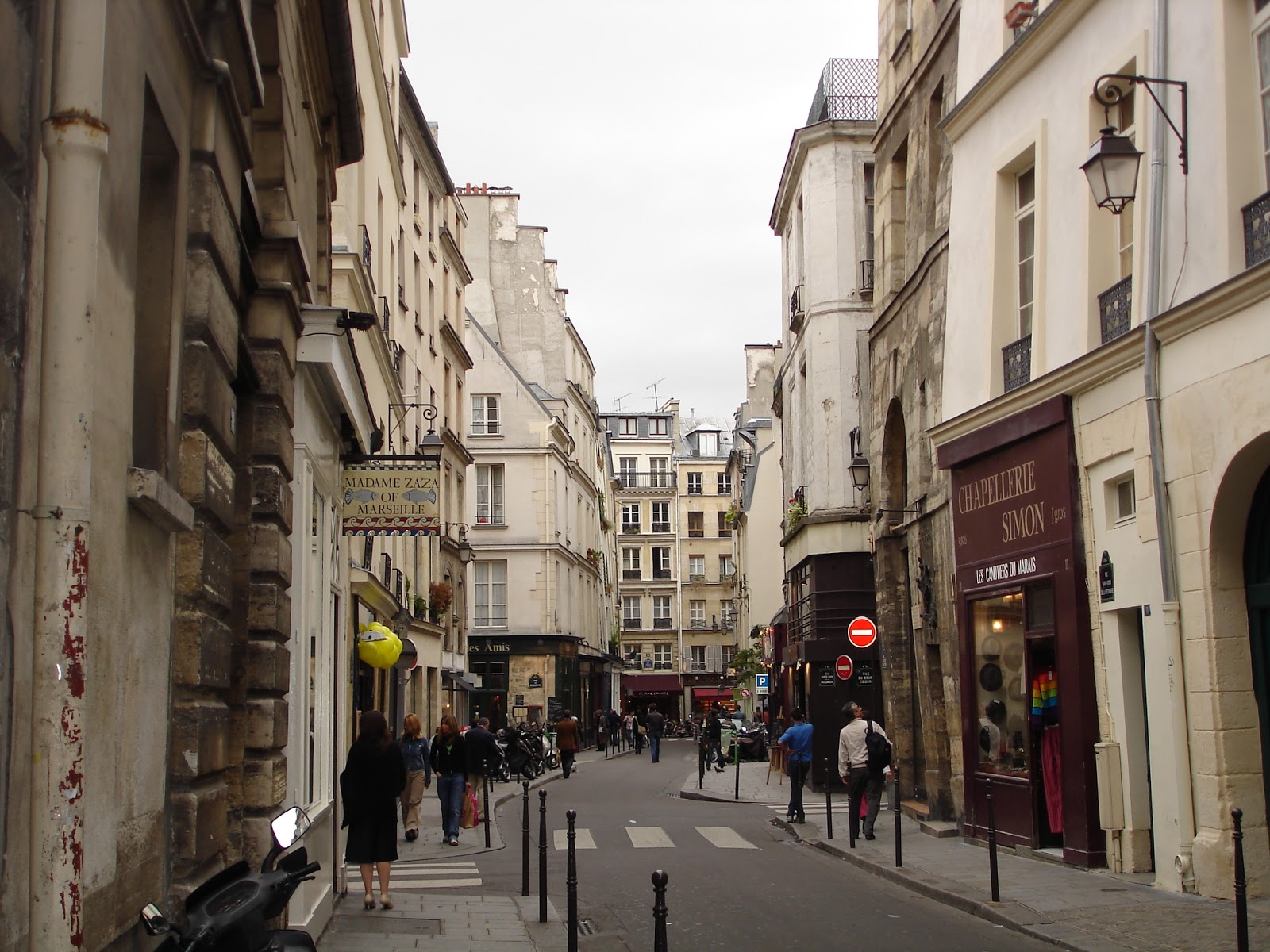
Paris' Marais neighborhood lies on the Right Bank not too far from Notre Dame.  It is one of the few parts of the city that was not completely demolished and rebuilt during the nineteenth century.  That means that many of its streets still wind around keeping their medieval flavor. 

The area has long been a Jewish quarter and more recently has added a lively gay community. And as in most of the large European cities I've visited, graffiti graces many buildings and alleyways of the Marais. This is one of my favorite parts of Paris, and I've stayed there for my last few visits. 

During my most recent visit, as I  walked down Rue Vielle du Temple, the street near the apartment my family had rented, I noticed a large cartoon-like bird painted on the side of one of the stores.  At first, I didn't pay much attention.  After all, the painting was surrounded by the more usual graffiti - and beautiful Parisian architecture.  After a few days, I finally realized that I kept seeing similar birds in various locations so I started looking for them.  Each colorful picture contained a logo: Birdy Kids.  


Of course I was curious, so like most somewhat tech-savvy people, I turned to Google.  I couldn't find too much information online about Birdy Kids  and most of it is written in French.  However, I did find the Birdy Kids website. With the aid of Google Translate, I read their manifesto:  "Welcome to the Birdy Kids. Founded in 2010 Birdy Kids consists of three young artists gathered around a common project: Street Art playful and colorful for everyone."


When I tried to dig deeper to find out more by reading an article about the "Birdy Crew", Google Translate failed to translate so I resorted to reading the article using my extremely limited French gained from two years of City College classes.  From this article I learned that the three members are Guillaume, Gautier and A.E.M.  Two of them are native Parisians and one hails from Lyon, France.  They are now based in Lyon but travel to many European cities to paint their street art.  From what I can tell, I was extremely fortunate to see their creations in Paris since some of their work went up just before I got there.

I also found Birdy Kids on YouTube.  In the video below, you can see them at work on some of their creations.
I'm not sure why I was so fascinated by these birds. Perhaps it is their childlike quality and bright colors.  Perhaps I just enjoyed the surprise of finding them as I walked the streets of Paris.  I'm sure there are many who turn up their noses at Birdy Kids' art, saying is is just more graffiti defacing buildings.  However, I disagree. I love these birds because they made me smile.


Friday, July 12, 2013

What Goes Around...


In her blog on "Logging Your Process", my friend Barbara Ann Yoder, a writing coach and teacher with her own website and blog, mentioned one of my posts about writing that appeared here at Poet Teacher Seeks World.  My post was inspired by writing advice I got from Barbara.  Now you can read her own post about how tracking one's writing can help help writers work through (or around) bad patches. Barbara wrote: "My friend Lisa Rizzo also had good luck with this exercise. She wrote a post about it called “What Is ‘Real’ Writing?"  Check out both posts. 

Monday, May 27, 2013

Who Will You Be in Ten Years?

-->
Can you imagine yourself 10, 20 or 30 years from now?  Who will you be? What will you care about?  According to an article I read recently, few of us can predict the answers to these questions.  “You Can't See It, But You'll Be A Different Person In 10 Years” by Nell Greenfieldboyce from NPR discusses this very subject.  Daniel Gilbert, a psychology researcher at Harvard University has found that even those of us with many decades under our belts cannot imagine how we might feel differently in the future. According to the article, “[Researchers] found that people underestimated how much they will change in the future. People just didn't recognize how much their seemingly essential selves would shift and grow. And this was true whether they were in their teen years or middle-aged.”

What astounds me most about this idea is that even while considering this, I am still unable to conceive of feeling any differently or changing my wants and desires in the next 10 years.  So that means even though I can look back at my 30-year old self and, with the wisdom of middle-age, chuckle at the young woman I was then, in another 10 years I might have just as much to laugh about.


Lately, I’ve had reason to ponder mightily on this subject.  After living in a wonderful home in a great community for eleven years, my sister, her husband and I decided to sell our house and move. We had spent the last decade renovating two bathrooms, a master bedroom, re-landscaping the yards, and planting trees and flowering shrubs to create a haven for wildlife. Only a little over a year ago we made a major renovation to our kitchen, combining all our desires into one dream room.  In December we threw a party for over 60 people to show them the new kitchen.
 And then – after believing that I would live in that very house until I retired or even long after retirement, we decided to sell.  It doesn’t matter that the idea came from my brother-in-law, or that he had to convince me the move would be a positive thing.  The important thing is that I went from resistance and fear to embracing that change, and embracing a new place to house my ever-changing self.


Even though I have moved many, many times throughout my adult life, somehow this one was different because I never expected it to happen.


I didn’t tell anyone about our move until all was said and done because I knew none of my friends and family would believe our decision.  It was difficult to explain the change of heart that had led to the decision. mostly because I was flabbergasted at myself.


  How could I have been so short-sighted?  After all, I have lived in eight other places throughout my adult life.  Each one was the right place for that time in my life.  As I grew older, what I wanted changed as well.  Yet, even with all that experience behind me - just as Daniel Gilbert predicted - I surprised myself once again.

Saturday, February 2, 2013

The State of Poetry in America?

The day after President Obama's second inauguration, I read an article from The Washington Post titled Is Poetry Dead?.  The author of this post, Alexandra Petri, based her argument on the allegedly dismal state of American poetry on the inaugural poem "One Today" written and read by Richard Blanco.  Ms. Petri took great offense to some of Blanco's language, stating that his poem, and American poetry in general, weren't "loud enough."

Petri criticized the poem in question for not being radical - "yowling" was the word she used.  Just what did she think Blanco should say -- that we are a nation of gunslingers who kill little children? That the rich keep getting rich while the majority of us suffer for it?  That there are still people in this country who make  racist remarks about our elected President?  Did she really think that the inauguration was the time and place for such poetry?

Personally, I feel sympathetic about Blanco's assignment since I have a little experience in writing a poem for a special occasion.  Ten years ago, when my sister got married, she asked me to write a poem to read as part of her wedding ceremony.  I was quite touched - until I started trying to figure out what to write.  Now I am not putting myself forward as a poet of the same caliber as Blanco, nor was my sister's wedding broadcast on national television.  But I do imagine that Blanco faced similar issues:  the topic of such a poem has to be related to the ceremony and can't be controversial.  At a wedding, like an inauguration, everyone wants to come away moved by the poet's words, but still feeling good.

In her blog, Petri went on to criticize poetry readings, MFA programs and just about everything else to do with poetry today.  I'm not sure what her beef with MFA programs are unless she is saying they are responsible for killing poetry.  However, I need to ask, are there no master's programs in journalism that pump out bad writers?  She rather quickly pointed out the connection between the supposed death of poetry and the death of newspapers, but just as quickly posits that journalists don't have to worry as much as poets since people will always want news.  I see a bit of a problem with her argument.  Just as there are good poems and bad poems, there is good journalism and bad journalism. I doubt she would like poets to say journalism is dead because People Magazine exists.

I read this article just as I was preparing for a poetry reading shared with my friend Casey FitzSimons at Florey's Books in Pacifica, CA.  Florey's is a tiny independent bookstore probably kept afloat by loyal local fans.  (I know whenever I go there for a poetry reading, I always make sure to buy at least one book.)   I wondered, if poetry is dead, should I even bother going?

Well, I'm happy to report that, unlike Petri's idea of poetry readings, there were about 30 people at the event - and not all of them were my friends and family.  During the evening, poems on several topics were read - and surprise, surprise, some of them were even controversial.  I heard poets' words on growing up gay, schizophrenia, the school massacre in Sandy Hook.  I heard enough anger - and a few tears - to make even Petri happy.

Obviously Petri thinks she is amusing, since she uses the subtitle "Alexandra Petri puts the "pun" in pundrity."  Like all writers, she wants people to read her words and respond - and at least with this post she succeeded. At last count she has garnered 377 comments.  Of course, some are from those who agree with her, but even more from those who protest her words; those who, according to her, should despair for poetry today.  

I don't know if Blanco's poem will be considered great enough to be read through the ages. Certainly Petri doesn't think so.  However, unlike her, I enjoyed this poem because, while not an angry rant, it did touch on sensitive topics:  poverty and racism, the death of children and Martin Luther King Jr.'s "I have a dream" that has still not come to full fruition.  I enjoyed Blanco's poem because it spoke of the aspiration that our country someday will be a safe place for us all. While the words he ended with were quiet, I found them powerful because he spoke of the hope for change, the kind of hope that can be the most radical idea of all.  Sometimes a quiet poem can make a loud noise.